
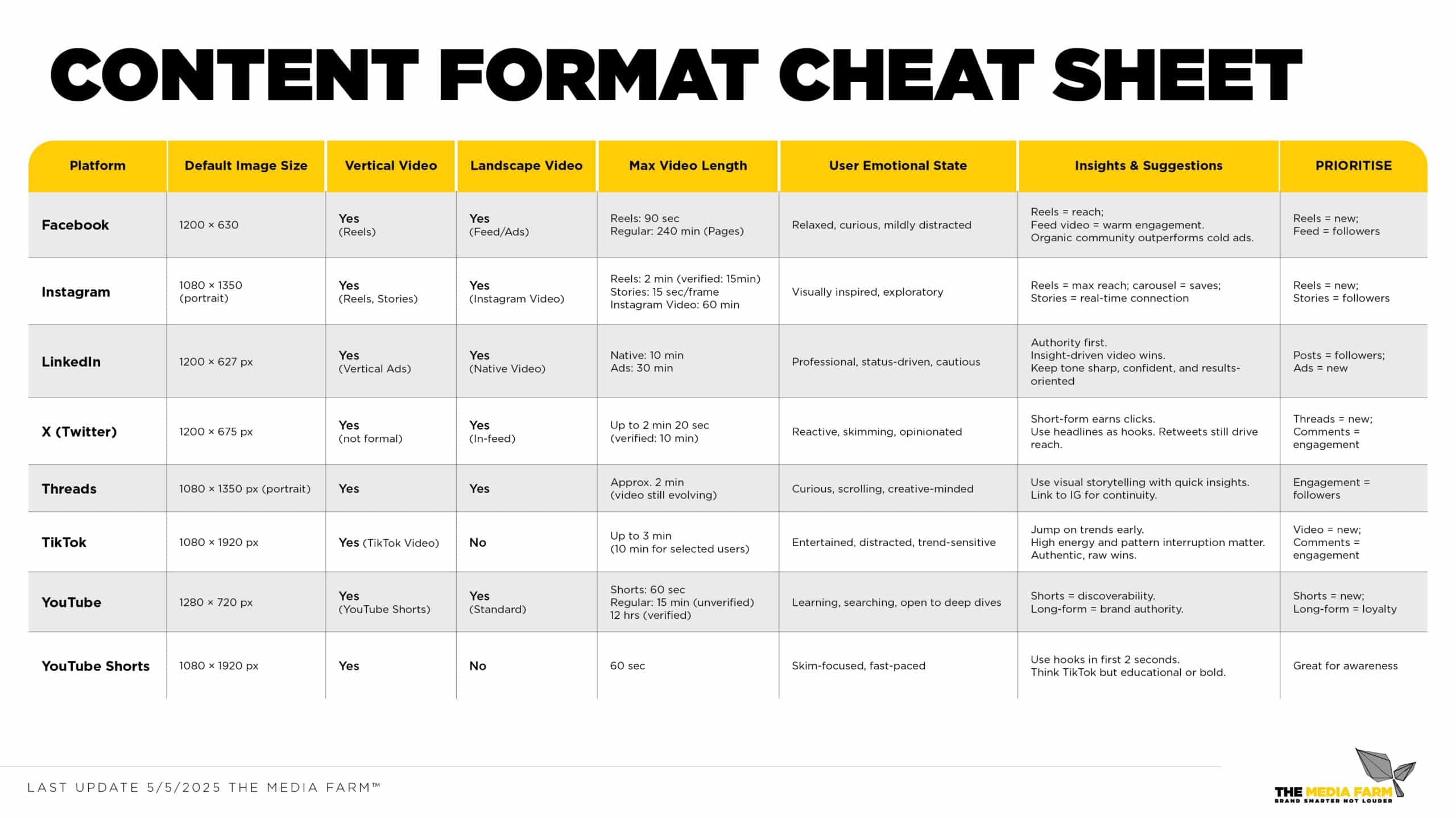
THE Social Media Cheat Sheet Every Brand Should Know

Most content isn’t bad — it’s just in the wrong place.

Since the introduction of TikTok’s “For You page, every other social media platform has either implemented or is slowly moving away from profile accolades (follower count and engagement rate) to an interest graph-based algorithm that will display content based on user interests.

This is great for you (no pun intended) because it means your content can play with the big boys, go viral and be seen by millions of new eyeballs, regardless of your profile history.

If you’re using the same post across LinkedIn, Instagram, TikTok and YouTube, you’re missing the nuances that make content convert. Platforms don’t just differ by size. They vary by audience intent, emotional context, and what your content is expected to do.

Here’s what you need to know:

FACEBOOK

  • Best for: Reels to reach new people and long-form videos for the community.
  • User mindset: Relaxed, mildly distracted, passively consuming.
  • Key insight: Organic reach is still strong if you post consistently and encourage discussion.
  • Platform prioritises: Reels = new audiences. Feed video = warm engagement.

INSTAGRAM

  • Best for: Reels, stories, and carousels.
  • User mindset: Visual, aesthetic, emotionally engaged.
  • Key insight: Reels reach new people. Stories and carousels nurture existing fans.
  • Priority: Reels = reach. Stories = retention.

LINKEDIN

  • Best for: Insight-driven video, carousels, and strong thought leadership.
  • User mindset: Professional, cautious, status-driven.
  • Key insight: Lead with value. Don’t sell — teach, reflect, or inspire.
  • Priority: Posts and articles = followers. Ads and webinars = non-followers.

X (TWITTER)

  • Best for: Opinions, one-liners, news commentary, bold positioning.
  • User mindset: Fast, reactive, curious.
  • Key insight: The right take at the right time wins. Speed > polish.
  • Priority: Use threads to engage followers. One-liners and retweetables reach new ones.

THREADS

  • Best for: Conversational tone, behind-the-scenes, and personality.
  • User mindset: Curious, exploratory, and still evolving.
  • Key insight: It’s not crowded — yet. Easy to stand out with consistency.
  • Priority: Brand-building > broadcasting.

TIKTOK

  • Best for: Native-feel video that teaches or entertains.
  • User mindset: Seeking escapism, trends, or tricks.
  • Key insight: Authenticity wins. Highly produced = ignored.
  • Priority: Every post has viral potential if it lands with the algorithm.

YOUTUBE

  • Best for educational content, in-depth storytelling, and SEO-friendly topics.
  • User mindset: Invested, committed, open to long-form.
  • Key insight: YouTube is a search engine. Think discoverability.
  • Priority: Consistent, searchable content builds subscribers.

YOUTUBE SHORTS

  • Best for: Hooks, short wins, and outtakes from longer videos.
  • User mindset: Quick scroll, low commitment.
  • Key insight: Great for channel discovery — use Shorts to drive subs to long-form.
  • Priority: Discovery > depth.

Download the cheat sheet PDF now.

Or, if you’re part of our free Branding School journey — it’s already in your Brand Book.


SIGN UP FOR BRANDING SCHOOL

Branding School is a free, 6-part strategic framework that helps you clarify your brand, attract better clients, and create content that converts.

Share this with someone?

LinkedIn
WhatsApp
Facebook
Twitter
Email

GET IN TOUCH

MORE FROM OUR BLOG

Brand Strategy is Poker The Media Farm
Articles
John-Henry Opperman

Your Brand Strategy Is Poker, Not Chess

Most people treat brand strategy like chess — calculated, predictable, and fully visible. But in the real world, branding plays more like poker: incomplete information, shifting odds, and constant adaptation. This article explores why the best brand strategies embrace uncertainty, experiment intelligently, and focus on resilience over control — with insights drawn from unexpected brand crises and behavioural economics.

Read More »
What is the difference between marketing and branding
Branding
John-Henry Opperman

Marketing vs Branding. What’s the difference?

Branding creates advocates. Marketing creates leads.
Branding is long-term. Marketing is short-term.
Branding defines your trajectory. Marketing helps your cash flow.
Branding is about getting people to feel something. Marketing is about getting people to do something.

Read More »
What to share on social media. Drive engagement now
Articles
John-Henry Opperman

What to share on social media. Drive engagement now

People will share content because of:

Social Currency: The content allows someone to seem informed, intelligent, progressive or anything that could resonate with their identity.
Triggers: What keeps people talking about things after the fact,

Emotion: Ideas that spark happiness, anger, sadness, whimsy will be shared more than ideas that don’t.

Practical value: It’s built into our DNA, help them survive, and it will thrive.
Story: Information can travel under the guise of what seems to be a story.

Read More »
What is video watch time
Articles
John-Henry Opperman

How to win with video – Understand watch time

Room 1: The Brand Room is where we ensure the business strategy is aligned with the brand strategy. Room 2: Workshop, Where we create the content, mix, match and replicate things and Room 3: Where we measure the performance of what we have done. This is a glimpse into Room 3; welcome to The Lab. 

Read More »
Free tools for your brand
Articles
John-Henry Opperman

7 Free tools to help your brand stand out.

These tools are for anyone who wants to level up their brand’s presence through consistency and overall look. At our studio we use them all the time and now we are sharing them with you! Mahala.

Read More »
TEACH YOURSELF 100 SETSWANA PHRASES
Articles
John-Henry Opperman

Teach Yourself 100 Setswana Phrases

As someone who can haphazardly butcher my way through a conversation in Sesotho, I have always found it incredibly inspiring to see racial and cultural divides dissolve just because someone can drop a line or two in local vernacular.

Read More »
WHAT iS CONTENT MARKETING
Articles
John-Henry Opperman

What is Content Marketing?

There rests a massive responsibility upon the shoulders of any content creator to be authentic, ethical and honest. We all know that attention is the new currency, but we should never allow hype or gimmicks to wag the dog. Be kind.

Read More »